
Space-Themed Slots and the Evolution of Sci-Fi Game Design
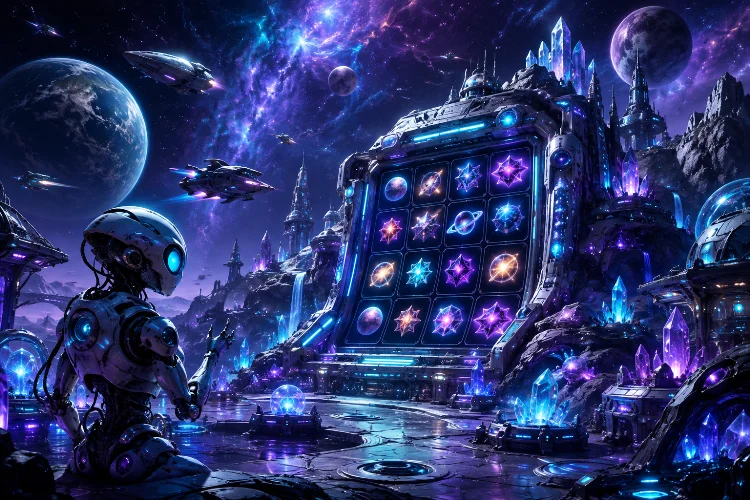
A classic slot machine does not give designers much room for world-building. There are reels, symbols, buttons, and perhaps a simple background. Move that same idea into a fictional galaxy, however, and almost every part of the interface can suddenly become part of a story.
That freedom has helped Space-Themed Slots develop alongside the wider world of science-fiction gaming. Space settings have appeared throughout video-game history, from the pioneering Spacewar! in the 1960s to arcade shooters, space simulators, exploration games, and modern online titles.
Slot designers have borrowed from that long visual tradition while creating their own approach: shorter interactions, instantly recognisable characters, dramatic feature animations, and mechanics wrapped in futuristic terminology.
The result is a category that has changed considerably over time.
Early Sci-Fi Slots Kept the Format Familiar
One interesting thing about older digital space slots is that many retained conventional slot structures.
The setting changed, but players still encountered recognisable reels, paylines, wilds, and respins.
Play’n GO’s Space Race, released in November 2012, is officially described as a sci-fi video slot centred on a journey through space toward the Moon. NetEnt followed with Space Wars in April 2013, using five reels, four rows, 40 fixed paylines, stacked symbols, and a cloning respin mechanic.
These games demonstrate an important stage in sci-fi slot design.
The universe looked futuristic, while the structure remained relatively familiar.
That made space an accessible theme rather than a completely different type of game.
Modern Space Games Are More Willing to Break the Reel Format
Digital design eventually allowed developers to move much further away from the mechanical-slot template.
Grid layouts are a good example.
Play’n GO’s Reactoonz uses a 7×7 grid and cluster wins rather than a conventional set of paylines. Matching aliens disappear after winning combinations, new characters fall into the empty spaces, and collected energy activates additional features.
Diamond Vortex, released in 2020, is also classified by Play’n GO as a grid slot with a sci-fi theme.
Space works particularly well for these less traditional structures because players do not expect realistic rules.
Symbols can fall through portals, disappear into energy fields, or transform through fictional technology without feeling visually out of place.
The theme essentially gives developers permission to be creativly strange.
Sci-Fi Language Helps Explain Complex Features
Modern slot mechanics can be surprisingly complicated.
There may be several meters, multiple types of wilds, cascading wins, modifiers, upgrades, multipliers, bonus modes, and persistent progression within one game.
Presenting these as purely mathematical systems could make the interface feel dry.
Sci-fi terminology turns them into part of the fiction.
In Reactoonz 2, for example, winning symbols can create Electric Wilds, while the Fluctometer and Quantameter collect energy toward additional effects.
Those names are playful, but they also give each mechanic an identity.
Instead of remembering “meter number two”, players remember a fictional piece of technology.
Mechanics and Theme Can Reinforce Each Other
This relationship works best when the mechanic visually makes sense.
A cloning feature fits an alien laboratory.
A multiplier can resemble an energy reactor gaining power.
Cascading symbols can be presented as objects teleporting out of a grid.
An expanding wild can become a giant alien invading the screen.
When mechanics and presentation support each other, the game feels more coherent than if a sci-fi background were simply placed behind unrelated reels.
Alien Characters Turn Slots Into Recognisable Worlds
Characters have also become a larger part of modern slot branding.
Play’n GO’s Reactoonz universe is a useful example because the concept has continued across numerous releases. The original Reactoonz arrived in 2017, Reactoonz 2 followed in 2020, Gargantoonz appeared in 2023, and Reactoonz 100 was released in October 2025.
The later games did not simply reuse a generic outer-space background.
They developed recurring characters and ideas.
This is closer to the way traditional video games build sequels and fictional universes. Familiar characters can become the connective tissue between mechanically different releases.
It also demonstrates how slot studios increasingly treat visual identity as something that can extend beyond one isolated game.
Space Themes Work Particularly Well With Animation
Sci-fi artwork almost invites movement.
Spaceships fly. Energy beams pulse. Portals rotate. Planets move slowly in the background. Alien machinery flashes and mechanical interfaces react to player input.
This gives animation a natural role.
Play’n GO’s Iron Girl is built around an intergalactic bounty hunter and was notable for using 3D graphics in its Iron Armor feature, something the developer highlighted when discussing the game.
Animation can help bonus events feel more significant, but there is a balance.
Too many effects can make a small phone screen feel clutered. The reels, symbols, balance information, and controls still need to remain readable.
Good sci-fi design therefore depends as much on restraint as spectacle.
Mobile Gaming Encouraged Stronger Visual Simplicity
A desktop monitor offers room for complex scenery. Mobile devices do not.
On a phone, individual symbols may only occupy a small part of the display. A detailed spacecraft that looks fantastic at full resolution can become an indistinct shape once reduced.
That encourages developers to favour strong outlines, exaggerated characters, glowing objects, and high-contrast visual elements.
Official Play’n GO pages for sci-fi titles such as Space Race, Iron Girl, Reactoonz 2, and Invading Vegas Revenge on Mars all include mobile as well as desktop presentations.
The broader design challenge is therefore not simply “make space look impressive.”
It is “make space look impressive on a small touchscreen without damaging readabilty.”
That has pushed sci-fi slots toward a more graphic, icon-like visual language.
Space Can Support Serious or Playful Stories
Another reason the theme remains useful is its range.
Science fiction does not have to mean one particular tone.
Iron Girl frames space around an intergalactic bounty hunter. Reactoonz uses colourful cartoon aliens. Invading Vegas Revenge on Mars mixes Martians with a playful interplanetary casino narrative.
Developers can also use retro rockets, distant planets, robots, advanced civilisations, cosmic crystals, or futuristic military imagery.
That flexibility matters because themes need to differentiate games that might otherwise share similar mathematical structures.
Two slots can both use cascades and multipliers while feeling completely different because one presents them as magic and the other as alien technology.
The Theme Keeps Evolving Rather Than Disappearing
Space-themed gaming is hardly new, but recent releases show that it has not been left behind.
Play’n GO released Gargantoonz in 2023, Invading Vegas Revenge on Mars in February 2025, and Reactoonz 100 in October 2025. NetEnt’s catalogue meanwhile continues the Space Wars concept through later titles such as Space Wars 2 Powerpoints and Space Wars Megaways XXXtreme.
That does not prove every player suddenly prefers sci-fi.
It does show that developers continue finding new ways to combine cosmic settings with newer slot structures.
The space theme survives because it can absorb changing mechnics rather than being tied to one design era.
Sci-Fi Presentation and Game Mathematics Are Separate
An important final point is that appearance should not be confused with mathematical performance.
A slot filled with supernovas, giant robots, and dramatic explosions is not automatically more volatile or more rewarding.
NetEnt, for example, separately lists information such as RTP, hit frequency, maximum payout, reels, and paylines for Space Wars.
Those statistics describe parts of the mathematical design.
The aliens describe the theme.
Players comparing games should therefore check the actual rules and available game information rather than assuming a dramatic visul style tells them anything about likely outcomes.
Space-Themed Slots have evolved from familiar reel games with cosmic artwork into richer sci-fi experiences using grids, cascading symbols, characters, energy systems, and animated features. Their lasting appeal comes from flexibility: almost any mechanic can be translated into futuristic fiction. When exploring these games, notice how well the mechanics, interface, and story work together instead of judging them only by flashy space graphics.